

An atmosphere of nervous excitement. I can see the frosty air emanating from my rivals as they execute the "pre-race" wiggle on the starting line.
A rapid twitch of the hips.
I'm lined up for my local weekly parkrun event and I'm serious. The countdown begins...
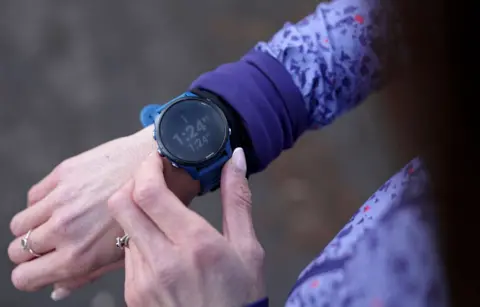
Wait a second. I have to sort my tracker. As does the runner alongside me.
The person behind us tuts. I'm not moving until… there! Connection established, I'm off.
In the mele, it's hard to spot a arm without a wearable on it. And it's not just us participants who rely on them.
We're witnessing a booming, massive sector. Companies like Apple Watch lead the market, all offering an broad selection of various devices to cater to a spectrum of budgets. Based on how advanced the model you choose, prices can start from a hundred pounds to thousands of pounds.
"It drives me insane, I can't stop checking."
"It reassures me… It's like a companion guiding me."
"Stop telling me I've experienced a poor sleep."
Just some of the comments people have shared from like-minded tracker enthusiasts when I question what they their opinion is on theirs.
The Data Dilemma
My feelings on mine? Currently, annoying. It's telling me I'm not hitting my target, causing me to question whether the trees I'm passing under are disrupting my GPS connection.
A vast number of us fasten these compact gadgets onto our wrists and keep them on all day and night, ostensibly unconcerned with the fact they're continuously tracking us.
A distant memory are the days when we relied on them solely to give us an idea of our step count. Now, they can measure our sleep quality, heart rate, oxygen saturation, our VO2 max.
It's difficult to find a health indicator they aren't designed to measure.
But can they do what they advertise? And are the statistics we analyse a accurate representation of our actual health? Do they improve our overall health, or do the avalanche of measurements and constant notifications just increase our sense of overwhelm?

Addiction or Aid?
"I become a quite obsessed with mine," a wearer confesses.
While she appreciates how her device tracks her workouts, she finds some of its other capabilities "daunting" at times - a feeling that became apparent during a pregnancy.
Until she found out she could change its configuration, her smartwatch kept telling her she was not being active enough. Later on, the watch frequently reports her she's had a poor sleep score.
"I have a infant, it's unnecessary for me to be notified I've not slept," she says. "I know that only too well."
Is it not possible to just remove it?
"I could, I suppose, but I've got this love-hate relationship with it," she continues. "I appreciate it for its exercise data, but I'm unsure whether all the other things it can now do is maybe excessive for me."
The Technology Behind the Tracking
Every device of smartwatch has its own proprietary way of measuring your vitals and analysing your data, but the vast bulk use detectors on the back of the watch.
They typically project minute LED lights onto your wrist which can monitor pulsation, identifying your pulse rate. Sophisticated devices detect changes in the skin conductance that flows through the skin to gauge your nervous system activity.
Expert Perspectives
A professor says that for most people for smartwatches, it's a "delicate equilibrium" - while the rapidly advancing tech could actually prevent illness, "identifying issues before we feel unwell", it could also turn us device users into the "concerned but fine".
He points out that some of the latest wearables can carry out tests like electrocardiograms (ECGs), which continuously monitor how stable the heart is. They can alert if someone is experiencing a heart arrhythmia, where there is irregular signals in the heart causing an uneven pulse.
This does not automatically signal someone is imminently going to suffer a cardiac event, but it can give an advance notice they might be more susceptible of a stroke in the future.
But how to make sense of these numbers is complex. The expert concerns that as more functions are added, people may find it hard to fully contextualise their data.
"I have some doubts that being able to monitor so many things is such a good idea," he says.
A professor studying patient behaviour echoes this sentiment. Her work into the effect of wearable tech on a cohort of individuals with health issues suggested a noticeable percentage of those who were given devices to monitor their condition experienced increased anxiety and were "more inclined to use doctor's time".
She identified a vicious circle with her patients - they spotted a alarming metric on their watch. They felt anxious. Their heart rate increased. They got more worried. They looked a second time, and their anxiety rose further.
"Upon viewing data about ourselves that we lack context for then, naturally, we are going to seek clarification," the psychologist says. "We look, we re-check - it becomes a self-fulfilling prophecy."


